
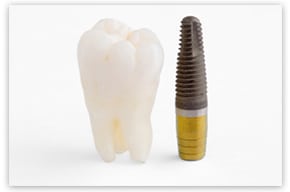
A dental implant bone graft may be necessary when the jawbone cannot support a dental implant.
Dental implant placement is usually a minor surgical procedure. Dentists perform it under sterile conditions in a dental office. Before the procedure, the dentist evaluates the jawbone carefully.
Sometimes the bone lacks the height or width needed for a stable implant. When that happens, the dentist may recommend bone regeneration before placing the implant.
These procedures rebuild the bone and improve implant success.
How Dentists Check Bone for Dental Implants
Dentists use imaging to determine whether a dental implant bone graft is needed.
Traditional dental X-rays show the height of the bone in two dimensions. However, they cannot accurately show bone width.
For better evaluation, dentists often use Cone Beam Computed Tomography (CBCT scanning).
This scan creates a three-dimensional image of the jawbone. It allows dentists to evaluate:
- Bone height
- Bone width
- Bone density
- Important nearby structures
CBCT scans also help dentists avoid critical areas such as:
- The maxillary sinuses in the upper jaw
- The inferior alveolar nerve in the lower jaw
Careful planning greatly improves the safety and success of dental implants.
Solutions for Inadequate Bone
Patients who have suffered bone loss after the loss or removal of teeth can undergo a simple procedure to provide enough support for dental implants. Common procedures include:
Sinus Augmentation
Sinus augmentation, also called a sinus lift, adds bone to the upper jaw.
This procedure increases bone height above the back teeth. Skilled surgeons perform it with highly predictable results.
After healing, the new bone can support dental implants.
Onlay Bone Graft Using Your Own Bone
Dentists sometimes use bone from the patient’s body. They place a small piece of bone on the area that lacks support.
Common donor areas include:
- The chin
- The back of the lower jaw
Over time, the graft fuses with the existing bone. Once the area heals, the dentist can place the implant.
Onlay Bone Graft Using Alternative Materials
Some patients prefer not to use their own bone. In those cases, dentists may use other graft materials.
These materials include:
- Bovine bone (from cows)
- Porcine bone (from pigs)
- Synthetic bone substitutes
These grafts act as a scaffold. New bone slowly grows into the material.
Healing usually takes three to twelve months before implant placement.
Guided Tissue Regeneration
Another option is Guided tissue regeneration.
During this procedure, the dentist places a special barrier over the bone defect. The barrier blocks fast-growing gum tissue from filling the space.
This allows slower-growing bone cells to rebuild the area. The barrier dissolves naturally after a few months.
Although these procedures increase the duration of your treatment, they greatly improve the outcome of implants placed. When used in the front of the mouth, bone grafting also allows for the creation of much better aesthetics.
Dr. Thein offers bone grafting and Sinus augmentation procedures to prepare patients for successful dental implant placement.
Contact the office at (833) 357-7578 for more information.