
Complex Dental Implant & Bone Grafting – Jack’s Case
Jack’s complex case involved long-standing missing teeth, bone and gum loss, periodontal care, bone grafting, sinus grafting and phased implant treatment.
What Made This Case Unique?
Patient Story, Treatment & Results
The original case photographs and treatment details are preserved below and presented in a clearer, properly aligned format.
Complex Dental Implant & Bone Grafting: Patient Problem, Planning & Treatment
Jack had long-standing missing teeth together with bone and gum loss, creating a complex implant reconstruction problem.
Advanced bone loss, periodontal disease and long-standing tooth loss can affect implant position, grafting needs, restorative space and long-term maintenance.
What Did This Case Require?
Patient Photographs, Treatment & Clinical Progress
The original photographs and clinical information from this published case are preserved below. Images are presented at consistent sizes to make the treatment sequence easier to review.

Before
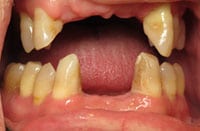
Before Close-Up
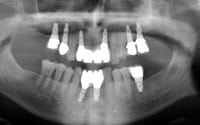
X-Ray of Dental Implants
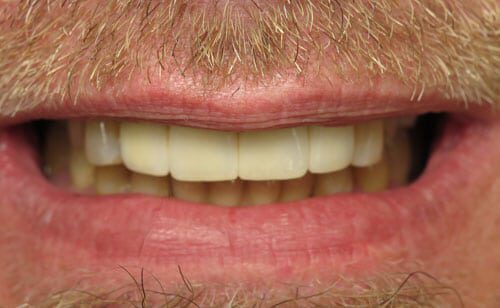
After
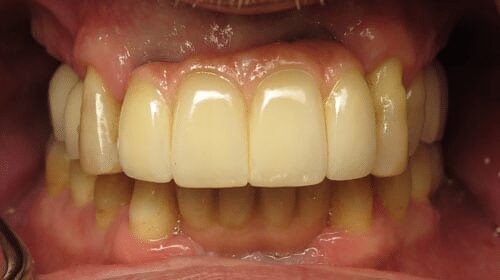
After
Jack from Apple Valley, California came to see Dr. Thein wanting to replace his missing teeth. He had served in Iraq and was quite conscious of his missing teeth to the point where it was difficult for him to go out. He told Dr. Thein that he had difficulties chewing his food but did not want partial dentures and bridges.
Since Jack had missing teeth for over 10 years, he had lost much of his gum tissue and bone. Dr. Thein explained to him that he’d need periodontal treatment (gum treatment), a block bone graft on the lower jaw, sinus bone grafts, and the placement of dental implants to restore his smile.

Working with Jack’s budget, over the course of two years, Dr. Thein was able to complete all of the treatments to restore his smile.
“Wonderful people!! Like family 🙂 The man makes miracles HAPPEN!”
Jack’s review on Yelp!
How This Type of Implant Case Is Evaluated
The published case involved periodontal care, bone grafting, sinus grafting and phased implant treatment, requiring coordination of disease control, bone reconstruction and restorative planning.
Evaluate the teeth, gums, bite and treatment area before deciding whether implant treatment is appropriate.
Assess supporting anatomy and the space required for the planned implant-supported restoration.
Implant position should support the intended restoration, bite and long-term hygiene access.
Implant care includes professional follow-up, home care and maintenance of the final restoration.
How Implant Placement and the Final Restoration Work Together
Treatment was phased, allowing periodontal stabilization, grafting and implant treatment to be sequenced around the clinical condition.
Dr. Robert Thein personally manages implant planning, surgical placement and final implant restoration at Boston Dental Care. This allows the surgical and restorative phases to be coordinated within one treatment plan.
Complex Dental Implant & Bone Grafting: Key Clinical Takeaway
Complex implant treatment may require rebuilding the foundation before implants can be placed in appropriate restorative positions.
Case studies demonstrate treatment possibilities rather than guaranteed results. Bone, gums, remaining teeth, bite, health and restorative needs vary for every patient.
Discuss a Similar Implant Problem With Dr. Robert Thein
Boston Dental Care is located at 3730 Foothill Blvd in La Crescenta, California. Dr. Robert Thein provides implant-focused surgical and restorative care for patients from La Crescenta, Glendale, Montrose, Pasadena, Burbank, La Cañada, Sunland, Tujunga, Eagle Rock and nearby communities.
Frequently Asked Questions
Can severe bone loss be treated with dental implants?
Sometimes, but additional bone reconstruction or alternative strategies may be needed depending on anatomy.
Why treat periodontal disease before implants?
Active periodontal inflammation and poor hygiene can compromise remaining teeth and implant treatment.
What is sinus grafting?
It is a grafting procedure used in selected upper-back-jaw cases when bone beneath the maxillary sinus is limited.
Why are complex cases treated in phases?
Phasing allows disease control, graft healing, implant integration and restorative steps to be sequenced appropriately.
Does every bone-loss case require grafting?
No. Treatment depends on the defect, implant position, available bone and restorative plan.
Why is experience important in complex implant treatment?
Complex cases require coordination of diagnosis, surgery, restorative planning, bite and maintenance.
Request an Individual Implant Evaluation
Bring your X-rays, previous treatment plan or implant records if available. Dr. Robert Thein can evaluate your current condition and discuss appropriate options.