
Single Front Tooth Dental Implant Case Study
A broken front tooth that could not be predictably restored was replaced with a single dental implant and an aesthetic final restoration.
What Made This Case Unique?
Patient Story, Treatment & Results
The original case photographs and treatment details are preserved below and presented in a clearer, properly aligned format.
Replacing a Broken Front Tooth With a Dental Implant
A broken front tooth can become both a functional problem and a highly visible cosmetic concern. This case demonstrates how a non-restorable front tooth can be evaluated for implant-supported replacement while considering the bone, gum tissue, bite and final appearance of the smile.
Front-tooth implant treatment requires more than simply placing an implant where a tooth is missing. The implant position must support the planned final crown, fit within the available bone, respect the surrounding gum tissue and coordinate with the neighboring teeth. The restorative result is therefore considered during the surgical planning stage.
What Made This Front-Tooth Implant Case Important?
Before, Treatment Progress & Final Smile
The original photographs from this published case are preserved below. They are presented in a larger, consistent format so the tooth condition and restorative result can be reviewed more clearly.
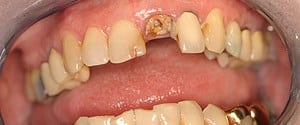 This patient broke her front tooth and wanted a makeover.
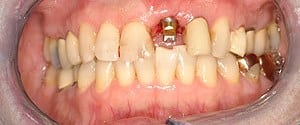 Patient during the process. Implant root form is placed, but the crown is not yet placed on the implant.
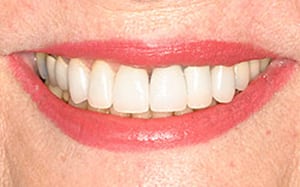 A close-up picture of her smile after the implant treatment was completed.
Why a Broken Front Tooth Requires Careful Diagnosis
A damaged front tooth should first be evaluated to determine whether it can be predictably restored. The remaining tooth structure, root condition, gum health, surrounding bone and bite all influence whether preservation or replacement is the more appropriate option.
When a front tooth cannot be predictably maintained, a dental implant may provide an independent replacement without requiring neighboring teeth to be prepared as supports for a traditional fixed bridge.
Key Diagnostic Questions
- Can the damaged tooth be predictably saved?
- Is adequate bone available for implant placement?
- Are the gums healthy and stable?
- Is there enough restorative space for the final crown?
- How does the tooth relate to the patient’s bite?
- How visible is the gumline when the patient smiles?
How a Single Front Tooth Dental Implant Is Planned
The exact treatment sequence differs from patient to patient, but front-tooth implant planning generally follows a diagnostic, surgical and restorative pathway.
The tooth, gum tissue, bone, bite and neighboring teeth are examined. Appropriate dental imaging may be used when clinically indicated.
The intended crown position helps determine the ideal implant position, angulation and available restorative space.
Implant placement is planned around bone support, soft tissue, neighboring roots, bite and the intended final restoration.
Shape, proportion, shade, contact with neighboring teeth, gum contours and bite are considered during the restorative phase.
Why the Surgical Position Matters to the Final Front Tooth
The visible crown is only one part of the treatment. The implant beneath it must be positioned so the final restoration can emerge in an appropriate location and function within the patient’s bite.
Dr. Robert Thein personally manages implant planning, surgical placement and final implant restoration at Boston Dental Care. This allows the surgical and restorative phases to be considered together rather than as unrelated procedures.
Single Front Tooth Implant vs. Traditional Dental Bridge
Independent Tooth Replacement
A dental implant replaces the missing tooth without using the neighboring teeth as bridge abutments, when implant treatment is clinically appropriate.
Tooth-Supported Replacement
A conventional bridge uses adjacent teeth for support. In some situations a bridge remains a reasonable option, particularly when neighboring teeth already require restorative treatment.
A Front-Tooth Implant Is Both a Surgical and Restorative Treatment
A single front-tooth implant may appear straightforward because only one tooth is being replaced. In reality, the visible location makes precise diagnosis, implant position and restorative planning especially important.
Case studies illustrate treatment possibilities rather than guaranteed results. Bone, gum anatomy, smile line, bite and the condition of adjacent teeth vary for every patient.
Single Front Tooth Implant Evaluation With Dr. Robert Thein
Boston Dental Care is located at 3730 Foothill Blvd in La Crescenta, California. Dr. Robert Thein provides implant-focused surgical and restorative care for patients from La Crescenta, Glendale, Montrose, Pasadena, Burbank, La Cañada, Sunland, Tujunga, Eagle Rock and nearby communities.
Frequently Asked Questions
Can a broken front tooth be replaced with a dental implant?
Yes, when the tooth cannot be predictably restored and the patient has suitable bone, gum health, bite and medical conditions for implant treatment.
Will a front tooth dental implant look natural?
The final restoration is designed to coordinate with the surrounding teeth and smile. The result depends on implant position, bone, gum contours, tooth proportions and shade.
Do front tooth implants always require bone grafting?
No. Bone grafting is considered only when existing bone is insufficient for the planned implant position or restorative support.
Can an implant replace one tooth without affecting neighboring teeth?
In suitable cases, yes. A single implant can replace one missing tooth without preparing adjacent teeth as bridge supports.
How is the final implant crown planned?
The crown is planned around the implant position, bite, neighboring teeth, restorative space, tooth proportions, shade and visible smile line.
Who performs the implant surgery and restoration at Boston Dental Care?
Dr. Robert Thein personally manages implant planning, surgical placement and final implant restoration, allowing both phases to be coordinated in one treatment plan.
How This Type of Implant Case Is Evaluated
Planning a front-tooth implant requires evaluation of the remaining tooth structure, gum tissue, available bone, spacing and the relationship of the tooth to the smile line.
Evaluate the teeth, gums, bite and treatment area before deciding whether implant treatment is appropriate.
Assess supporting anatomy and the space required for the planned implant-supported restoration.
Implant position should support the intended restoration, bite and long-term hygiene access.
Implant care includes professional follow-up, home care and maintenance of the final restoration.
How Implant Placement and the Final Restoration Work Together
The implant must be positioned to support an aesthetic final crown while respecting the surrounding bone, soft tissue and bite. The restorative phase then focuses on shape, shade and integration with adjacent teeth.
Dr. Robert Thein personally manages implant planning, surgical placement and final implant restoration at Boston Dental Care. This allows the surgical and restorative phases to be coordinated within one treatment plan.
Single Front Tooth Dental Implant: Key Clinical Takeaway
A single missing or non-restorable front tooth can sometimes be replaced with a dental implant without preparing the neighboring teeth for a conventional bridge.
Case studies demonstrate treatment possibilities rather than guaranteed results. Bone, gums, remaining teeth, bite, health and restorative needs vary for every patient.
Discuss a Similar Implant Problem With Dr. Robert Thein
Boston Dental Care is located at 3730 Foothill Blvd in La Crescenta, California. Dr. Robert Thein provides implant-focused surgical and restorative care for patients from La Crescenta, Glendale, Montrose, Pasadena, Burbank, La Cañada, Sunland, Tujunga, Eagle Rock and nearby communities.
Frequently Asked Questions
Can a broken front tooth be replaced with a dental implant?
When a front tooth cannot be predictably restored, a dental implant may be an option if the bone, gums, bite and medical factors are suitable.
Will a front tooth implant look natural?
The goal is to design the final restoration to harmonize with the surrounding teeth and smile. Results depend on implant position, gum contours, bone, shade and tooth proportions.
Do front tooth implants require bone grafting?
Not always. Bone grafting is recommended only when existing bone is insufficient for the planned implant position or aesthetic support.
How is the final implant crown designed?
The final crown is planned around the implant position, bite, surrounding teeth, shade and visible smile line.
Can I keep a temporary tooth during treatment?
Temporary tooth options depend on the clinical situation, implant stability, bite and aesthetic needs and must be determined individually.
Who plans the surgery and restoration?
Dr. Robert Thein personally manages implant planning, surgical placement and the final implant restoration at Boston Dental Care.