
Back Tooth Dental Implant Case Study
A missing posterior tooth was replaced with a dental implant to restore support and function without relying on adjacent teeth for a traditional bridge.
What Made This Case Unique?
Patient Story, Treatment & Results
The original case photographs and treatment details are preserved below and presented in a clearer, properly aligned format.
Back Tooth Dental Implant: Patient Problem, Planning & Treatment
A missing posterior tooth required replacement to restore support and function in the back of the mouth.
Back teeth carry substantial chewing forces. A missing posterior tooth can change force distribution and may affect neighboring or opposing teeth.
What Did This Case Require?
Patient Photographs, Treatment & Clinical Progress
The original photographs and clinical information from this published case are preserved below. Images are presented at consistent sizes to make the treatment sequence easier to review.
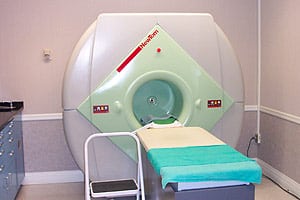 Dr. Thein uses an advanced CT Scan machine, interactive computed tomography, and computer design surgical guides to make implant surgery safer for his patients.
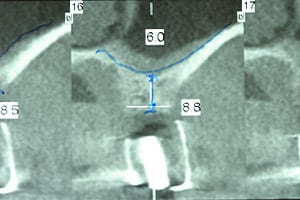 CT Scan images.
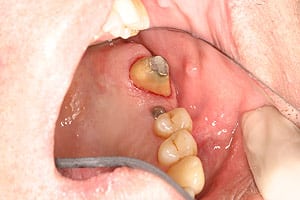 This patient was missing a tooth, which was a functional and a cosmetic problem for him. However, he did not want a conventional dental bridge.
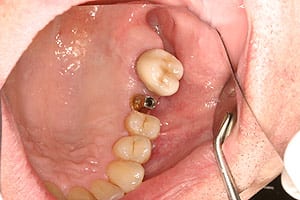 Dr. Thein did a sinus bone graft and placed an implant for this patient.
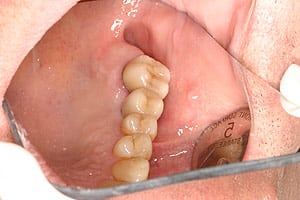 A few months after the surgery, Dr. Thein placed a custom made crown over the implant which acts just like a natural tooth!
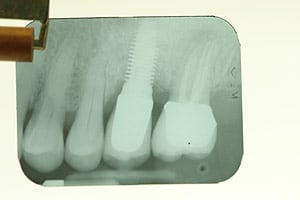 Here is an x-ray of the implant Dr. Thein placed. You can see that Dr. Thein also did a root canal on an adjacent dead tooth.
How This Type of Implant Case Is Evaluated
The implant site is evaluated for bone, restorative space, bite, neighboring roots and the forces expected on the final crown.
Evaluate the teeth, gums, bite and treatment area before deciding whether implant treatment is appropriate.
Assess supporting anatomy and the space required for the planned implant-supported restoration.
Implant position should support the intended restoration, bite and long-term hygiene access.
Implant care includes professional follow-up, home care and maintenance of the final restoration.
How Implant Placement and the Final Restoration Work Together
This case demonstrates replacement of a missing back tooth with a single dental implant and implant-supported restoration.
Dr. Robert Thein personally manages implant planning, surgical placement and final implant restoration at Boston Dental Care. This allows the surgical and restorative phases to be coordinated within one treatment plan.
Back Tooth Dental Implant: Key Clinical Takeaway
A single implant can replace a missing posterior tooth without using adjacent teeth as bridge supports when suitable.
Case studies demonstrate treatment possibilities rather than guaranteed results. Bone, gums, remaining teeth, bite, health and restorative needs vary for every patient.
Discuss a Similar Implant Problem With Dr. Robert Thein
Boston Dental Care is located at 3730 Foothill Blvd in La Crescenta, California. Dr. Robert Thein provides implant-focused surgical and restorative care for patients from La Crescenta, Glendale, Montrose, Pasadena, Burbank, La Cañada, Sunland, Tujunga, Eagle Rock and nearby communities.
Frequently Asked Questions
Why replace a missing back tooth?
Replacing a missing back tooth may restore chewing support and help maintain a more balanced bite.
Is a dental implant stronger than a bridge?
Implants and bridges are different options. The best choice depends on bone, adjacent teeth, bite, oral health and goals.
Does a back-tooth implant need a crown?
Yes. After integration, a restorative component and crown are generally used to create the replacement tooth.
How is bite pressure managed?
The final crown is adjusted to work with the patient’s bite and expected chewing forces.
Can a missing molar cause bone loss?
Bone dimensions can change over time after tooth loss, although the amount varies.
When is bone grafting needed?
Grafting is considered if available bone is insufficient for the planned implant position.
Request an Individual Implant Evaluation
Bring your X-rays, previous treatment plan or implant records if available. Dr. Robert Thein can evaluate your current condition and discuss appropriate options.